How to Store Pokémon Cards So They Don't Lose Value
Damp is what writes off collections — mold can start in about two days at 90% humidity. Light, pressure and PVC are slower. The fixes cost very little.
Damp is the thing that destroys collections. Everything else on this list — light, pressure, PVC — takes years and costs you a grade or two. A wet basement takes a weekend and costs you everything.
We buy collections in any condition, so we see the whole range: cards that spent twenty-five years in a shoebox on a closet shelf and look fine, and cards that spent one bad winter against an exterior wall and are spotted, wavy and worth a fraction of what they were. The difference is almost never how careful the owner was day to day. It is where the box sat.
Here is what actually causes damage, in the order we see it, and what each fix costs.
What damages Pokémon cards most often? Damp, then handling
Ranked by how often we find it when a collection arrives: moisture damage first, handling and pressure damage second, light third, PVC last. That order surprises people, because PVC gets talked about the most online and moisture gets talked about the least.
Moisture is first because it is catastrophic rather than gradual. The Canadian Conservation Institute’s guidance for paper objects, current as of August 2026, gives the timeline: mold can take as little as two days to grow at 90% relative humidity, about ten days at 80%, and around a hundred days at 70%. That is not a slow decline. That is a burst pipe or a humid August in an uninsulated garage, and the collection comes out stained.

What humidity and temperature should cards be kept at?
Aim for around 35% relative humidity in a cool, stable spot. That is the Library of Congress figure for works on paper, published in its collections care guidance and current as of August 2026, along with the instruction to avoid attics, basements and anywhere with leak risk or environmental extremes.
The Canadian Conservation Institute sets the hard ceiling: keep relative humidity below 65%, and avoid prolonged periods above 75%. It also quantifies the upside of dry storage — at 20°C and 30% humidity, a typical wood pulp paper lasts about twice as long as it does at 20°C and 50%. Cool helps too: as a rule of thumb, chemical degradation halves for every 5°C drop in temperature.
In practical terms, for a house rather than a museum: an interior closet on a living floor, off the floor itself, away from radiators and exterior walls. Not the garage. Not the loft. Not under the stairs next to the washing machine.

Does light really fade Pokémon cards?
Yes, and household light is enough. The Canadian Conservation Institute publishes fading tables by light level. At roughly 5,000 lux — described as the light from a window or a study lamp — highly sensitive colourants show a just-noticeable fade in four days to one month. Materials at the low-sensitivity end, which includes the natural color of paper itself, take about six months to eight years at that same level.

Card stock and modern printing inks sit across that range rather than at one point on it, so treat those numbers as brackets, not a prediction for a specific card. The practical rule is simpler than the table: cards in a closed box in a dark cupboard are not fading. Cards displayed on a shelf that catches afternoon sun are. If you display, use a spot that never gets direct sun, and rotate what is out.
Are PVC pages and binders damaging cards?
Old vinyl pages will damage cards, but slowly. The Smithsonian’s National Postal Museum, in its guidance on choosing safe plastics, states that vinyl — polyvinyl chloride, PVC — is neither safe nor stable, is highly reactive, and that the reaction will over time cause permanent damage to whatever is inside. The Canadian Conservation Institute gives the same instruction for paper collections: use only stable plastics free of plasticizers, such as PET (sold as Melinex, formerly Mylar) or polypropylene.
What that means for a real collection: sleeves and pages sold today by the main card brands are generally polypropylene and are fine. The problem is 1990s and 2000s binder sheets, the soft, slightly tacky, strong-smelling ones. If a page feels oily or the cards stick to it at all, get the cards out this week.
Both sources also make a point worth repeating. The National Postal Museum notes that “archival” is a marketing word with no regulation behind it. The thing to look for is the actual polymer named on the packaging — polypropylene, polyethylene, PET — or, for photographic materials, a “PAT Passed” mark from the Image Permanence Institute.
Amazon
Polypropylene penny sleeves
Check the listing names the polymer. If it only says 'archival', that word means nothing.
What does condition actually cost you in dollars?
Enough to justify a closet shelf. Take Base Set Venusaur, an ordinary holo that turns up in a lot of collections. Looking at eBay sold listings for the card in the first three weeks of August 2026: a raw copy described as near mint sold for $125.00 on 6 August. Copies described as lightly, moderately or heavily played sold for $50.00, $59.99 and $59.99 on 11, 10 and 9 August. Graded copies of the same card went higher still — a PSA 8 at $320.00 and a CGC 10 at $1,365.54, both on 18 August.
Two honest caveats. Condition labels on raw eBay listings are assigned by sellers and are not consistent, so read that raw spread as a range, not a scale. And the jump to the graded prices is not condition alone — a slab also buys authentication and easier resale.
The point stands anyway. Storage does not turn a played card into a mint one. It decides whether a card that is currently near mint is still near mint in ten years, and that gap is roughly double on a $100 card and much more than double at the top.
The setup that covers all four, cheaply
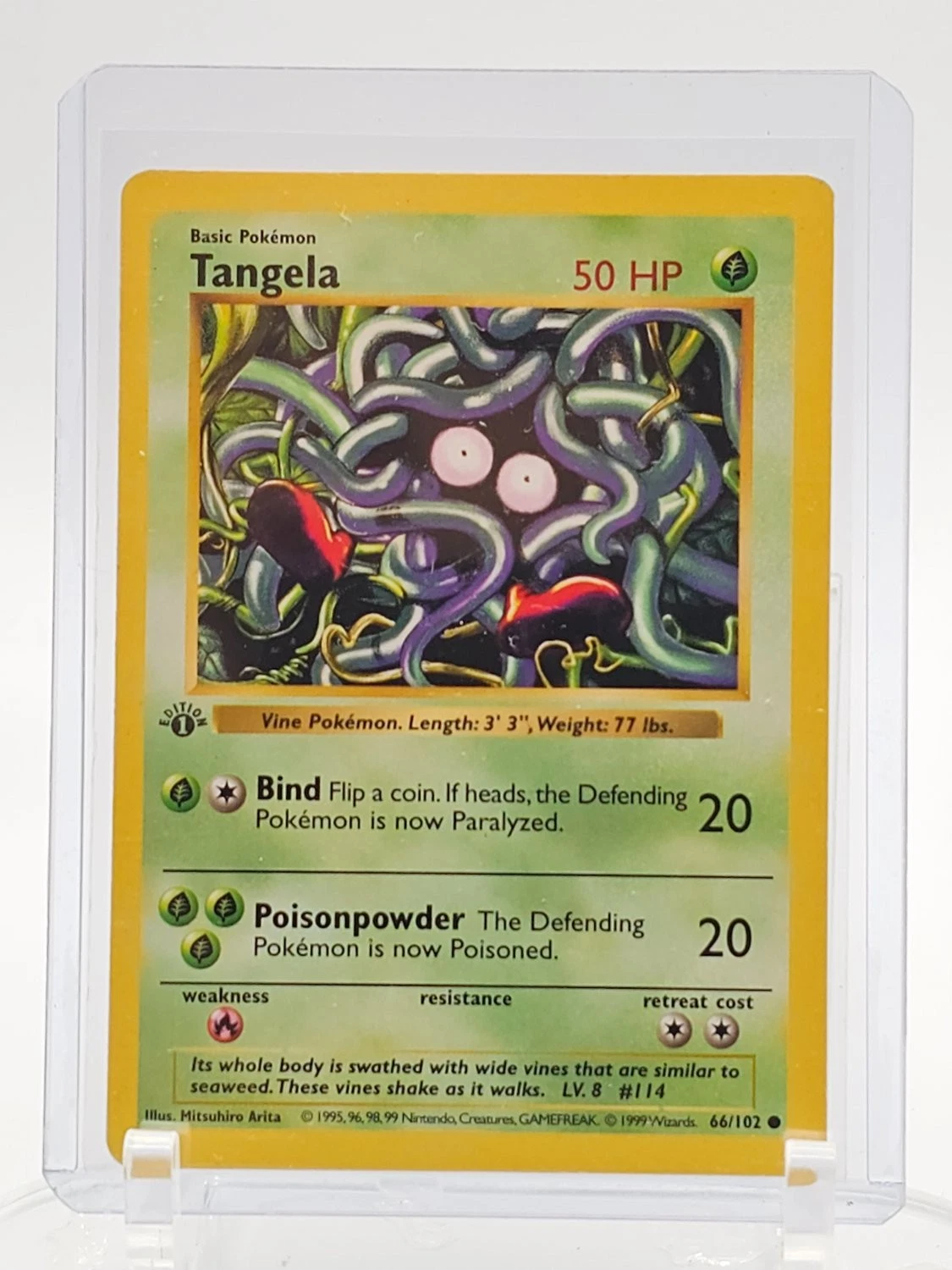
- Penny sleeve the holos, rares and anything from a 1990s set. Skip commons and modern bulk.
- Sleeved cards go upright in a cardboard card box, snug but not compressed. Rubber bands are the fastest way to crease a stack — the Canadian Conservation Institute lists them among the materials to keep away from paper entirely.
- Valuable singles go in a rigid holder, not a soft sleeve buried in a box.
- The box goes in an interior closet, off the floor, away from radiators, vents and exterior walls, and out of the light.
- If any of it is currently in a garage, basement, attic or storage unit, moving it is the highest-value thing on this list.
That is the whole system. It is not expensive, and it is mostly about location rather than product.
When storage stops being worth the effort
If the cards are already played, creased or sun-faded, careful storage from here protects what value remains but will not recover any. And if the collection is bulk — thousands of commons from the 2010s — the labor of sleeving it costs more than the cards are worth. Put it in a dry box and leave it alone.
The same logic applies to buying supplies. If a collection is worth a couple of hundred dollars and you plan to sell it this year, spending fifty dollars on sleeves and boxes to protect it is a bad trade. Keep it dry, keep it flat, and sell it.
When you do sell, condition is priced in but it is never a reason not to send photos. We buy collections in any condition — played, creased and sun-faded included, condition changes the price rather than the interest — and there is no minimum size. Offers go out within 24 hours of photos, insured shipping is covered on accepted offers, and payment is sent once the cards arrive and match the photos. If you want a number on what you have, send us photos.
Common questions
- What humidity should Pokémon cards be stored at?
- The Library of Congress recommends about 35% relative humidity for works on paper, in a cool, stable spot. The Canadian Conservation Institute’s floor is firmer: keep relative humidity below 65% and avoid prolonged periods above 75%, because that is where mold becomes active. Both figures are from guidance published on their own sites and current as of August 2026.
- Are PVC binder pages bad for Pokémon cards?
- Yes, over time. The Smithsonian’s National Postal Museum states plainly that vinyl (PVC) is neither safe nor stable, is highly reactive, and will cause permanent damage to whatever is inside the enclosure. The Canadian Conservation Institute’s advice for paper objects is the same: use only stable plastics free of plasticizers, such as PET or polypropylene. Modern card sleeves and pages from the major brands are usually polypropylene, but old vinyl sheets from the 1990s are not.
- Does sunlight fade Pokémon cards?
- It does, and faster than most people expect. The Canadian Conservation Institute’s fading tables show that at about 5,000 lux — the light from a window or a study lamp — highly sensitive colourants show a just-noticeable fade in four days to one month, and even low-sensitivity materials fade in roughly six months to eight years. A card taped to a bedroom window is on the fast end of that.
- Is a basement or attic a bad place to keep a card collection?
- Yes. The Library of Congress specifically names attics and basements as places to avoid for paper, because of leak risk and temperature and humidity extremes. An interior closet on a living floor is a better store than either, and it costs nothing.
- Is it worth putting every card in a sleeve?
- No. Sleeve the holos, the rares and anything from a 1990s set. Commons and modern bulk are not worth the labor — nobody pays more for a sleeved bulk common, and we do not either.