You Inherited a Pokémon Collection. Here's the Order of Operations.
A calm, practical order of operations for someone who has just inherited Pokémon cards and has no interest in the hobby: what not to throw away, what actually carries the value, and the two ways families end up underpaid.
Take a breath. Nothing here is urgent, and nothing is going to lose value in the next month. The one thing that genuinely matters in the first week is that nothing gets thrown out, cleaned, flattened, rubber-banded or split between people before anyone has looked at it properly. Everything else can wait.
If you have no interest in Pokémon cards and no intention of developing one, that is completely fine. You do not need to learn the hobby to avoid being underpaid. You need about four steps, in order.
Step one: put everything in one place and stop
Gather it all into a single box or corner of a room. Cards in binders, cards in shoeboxes, loose cards in a drawer, sealed packs, tins, boxes that look empty, folded posters, the lot. Then leave it alone.
Two specific things not to do:
- Do not clean anything. No wiping, no erasers, no water. A scuff is a scuff; a scuff someone tried to buff out is worse.
- Do not flatten, sort by hand into piles, or rubber-band. Rubber bands leave permanent indentations. Handling causes edge wear. Both cost real money on the small number of cards where condition matters.
If the storage is damp or hot, move the boxes somewhere dry and room-temperature. That is the only physical intervention worth making straight away. Our storage guide covers the rest if you end up holding onto the collection for a while.
Step two: do not throw away anything that is not obviously rubbish
This is where families lose the most money, and it happens fast, usually during a house clearance.
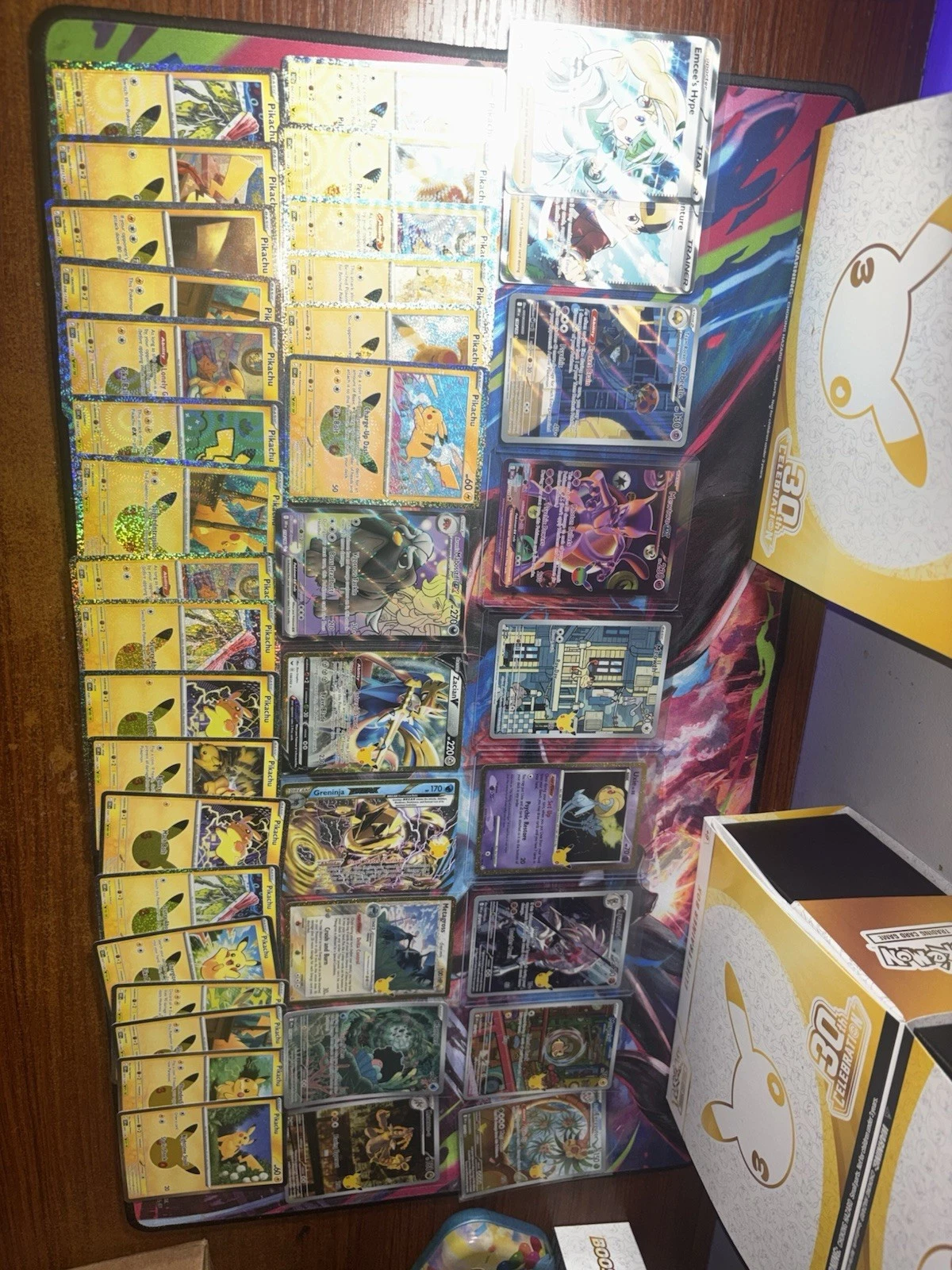
The things most often binned are the things that do not look like cards:
- Sealed boxes and packs. A sealed booster box from the 1999 Base Set has been selling at roughly $37,000 as of August 2026. That is a rare object and most collections will not contain one. But a sealed Evolving Skies booster box, from a set that came out in 2021 and sat on shop shelves, has been going for around $2,300. Sealed product is the single easiest category to accidentally throw away.
- Boxes and tins that look empty. Open them.
- Anything Japanese. Unfamiliar text is not a sign of a fake or a worthless card. Japanese printing is often better and some Japanese cards are worth more than the English equivalent. See Japanese vs English cards.
- Bent, water-marked or written-on cards. They are worth less, sometimes much less, but “less” is not “nothing”, and a damaged rare card can still be worth more than a whole binder of clean common ones.
You are not trying to identify anything at this stage. You are only trying to make sure the skip does not get there first.
Step three: understand where the value actually sits
Here is the part that no one tells families, and it is the single most useful thing to internalize.
In almost every collection, the value is concentrated in a handful of cards. Not spread evenly. Concentrated. These are all cards from the same 102-card 1999 Base Set, or from the same 2021 set, sitting in the same binders:
| Card | Ungraded | PSA 10 |
|---|---|---|
| Base Set Charizard #4 | ~$437 | ~$26,600 |
| Base Set Pikachu #58 | ~$5 | ~$540 |
| Base Set Rattata #61 | ~$1.39 | ~$86 |
| Evolving Skies Umbreon VMAX #215 | ~$2,025 | ~$4,250 |
Sold figures from PriceCharting, August 2026.
Two things follow from that table.
First, a collection can contain thousands of cards worth a cent or two each and still be worth a meaningful amount, because of five cards. Second, a collection can contain thousands of cards and genuinely not be worth much, because those five cards are not in it. Both outcomes are common and neither is predictable from the size of the box. Anyone who tells you which one you have before looking is guessing.
The modern card in that table matters too. A lot of people assume “old equals valuable, new equals worthless”. That Umbreon is from 2021 and it is not a small number. Do not let anyone wave off the recent-looking cards.
If you want to get a rough sense yourself before talking to anyone, our guide on what your collection is worth walks through it, and what Pokémon cards are worth money covers what to look for.
The first way families get underpaid: one price for the whole lot
Because value is concentrated, the easiest way to underpay someone is to price the collection as one undifferentiated pile.
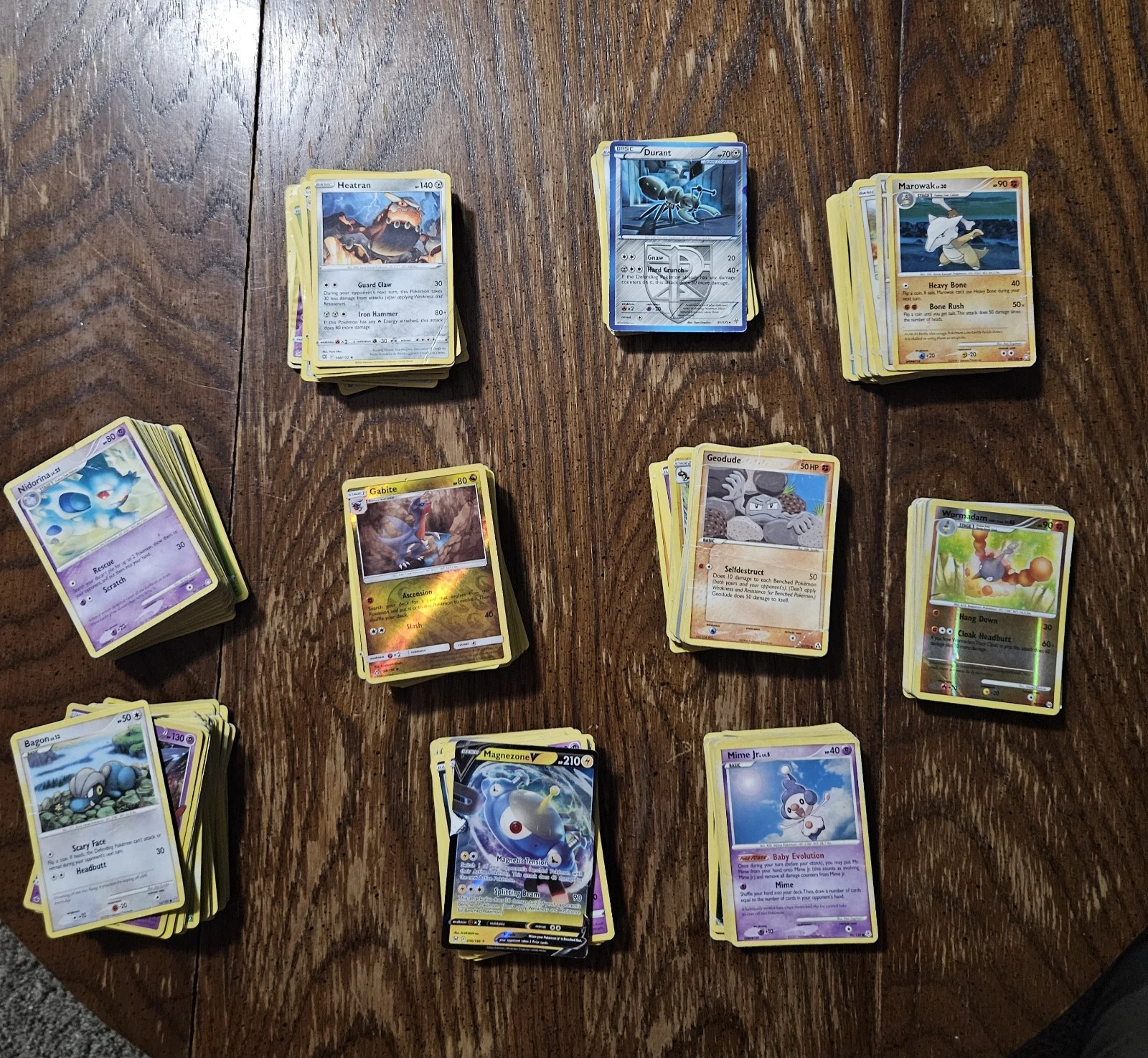
Bulk cards — the commons, the uncommons, the energy cards, the thousands of cards nobody chases — trade at rates measured per thousand. Sources vary on what that rate is. Collectors Emporium NY publishes $8 to $10 per 1,000 for commons, uncommons and rares, and $15 to $20 per 1,000 for holos and reverse holos. A 2026 bulk guide from Misprint puts the bulk-buyer range higher, at $15 to $25 per 1,000 for commons and uncommons.
Both are probably accurate for their own situation, and the gap tells you something useful: sorted, modern, clean bulk in large volume is worth more per card than an unsorted mixed box that someone has to dig through. Neither number is wrong, and neither number should be applied to a Charizard.
So the specific failure mode is this. A buyer looks at 4,000 cards, quotes a bulk-style number for the lot, and quietly keeps the six cards that carry most of the value. The offer is not fraudulent. It is just a bulk price applied to a collection that was not all bulk.
How to avoid it: any offer should distinguish between the bulk and the individually valuable cards. It does not need to be itemized down to every card, but it should say something like “X for these named cards, Y for the remaining bulk”. If an offer is a single number for everything with no breakdown at all, ask for the breakdown. A buyer who will not give you one is telling you something.
The second way: only getting one offer
The second failure mode is simpler. Someone gets one number, has no way to judge whether it is fair, and accepts it because the whole process is exhausting and they would like it to be over. That is an entirely understandable reason to accept an offer and a bad reason to accept a particular offer.
We buy collections. That means when we make you an offer, we are on the other side of the table from you, and you should treat our number the way you would treat any other buyer’s: as one data point.
Get at least two, ideally three. A local card shop, an online buyer, and — if the collection looks like it contains genuinely valuable cards — an auction house or a consignment service. They will come back with different numbers, structured differently, and the spread itself is information.
Check the individually valuable cards yourself. For any single card someone has named a price on, search it on eBay and filter to sold listings only. Asking prices are fiction; sold prices are the market. This takes about two minutes per card and it is the single highest-value thing a non-collector can do.
Expect a written offer. Ours is written, and priced from recent sold comps. A verbal number in a shop that changes when you push back was never a real offer.
More detail on the mechanics is in how to sell a Pokémon collection.
Step four: decide about grading — the answer is usually no
Grading is when a company encapsulates a card and assigns it a numerical condition score. It can multiply the value of a good card, which is why people ask about it.
For an inherited collection it is usually the wrong move, and the fee pages explain why. As of August 2026:
| Service | Cheapest available tier | Estimated turnaround |
|---|---|---|
| PSA | $79.99 per card (Regular, $1,500 max declared value) | 70–80 business days |
| CGC | $17 per card (Bulk, 25-card minimum) | 150 working days |
PSA’s cheaper Value tiers were paused at the time we checked, which is worth knowing if you have read older advice quoting much lower figures.
Now look back at the Rattata. A perfect PSA 10 copy sells for about $86, and the PSA fee alone is $79.99. Even the best possible outcome does not cover the cost. That logic applies to the overwhelming majority of cards in any collection.
Where it does make sense: a small number of genuinely valuable cards in visibly clean condition. A raw Base Set Charizard trades around $437; in a PSA 9 holder, around $2,900. That gap is large enough to justify the fee and the wait — and we will say that plainly even though we would rather buy the card raw. But it is a gamble on the grade, and it adds months to settling an estate. If the estate needs to close, selling raw is a perfectly reasonable choice.
Should you grade your cards? goes into the maths properly.
If more than one person has inherited it
Agree who is deciding before anyone talks to a buyer. Collections get split between siblings “evenly” by card count, which is the one division guaranteed to be unfair given how concentrated the value is. If the collection is being divided, get it valued first and divide the value, not the cardboard.
The short version
- Put everything in one dry place and stop touching it.
- Throw nothing away — especially sealed boxes, tins and anything that does not look like a card.
- Assume the value is concentrated in a few cards, and refuse any single-number offer for the lot.
- Get two or three offers in writing, and check the named cards against eBay sold listings.
- Do not grade anything before you know what you have.
None of this requires you to care about Pokémon. It takes an afternoon of photographs and a week of patience.
When you are ready, send us photos — the binders, the boxes, anything sealed, and close-ups of anything that looks unusual. We will price it against recent sold comps and send you a written offer with the valuable cards separated out from the bulk, so you can compare it against anyone else’s. If you post cards to us, shipping and insurance are your responsibility, and we pay after the cards arrive and we have reviewed them, not before. Whatever you decide, get a second number first.
Common questions
- Should I get inherited Pokémon cards graded before selling them?
- Almost certainly not the whole collection, and probably not any of it. As of August 2026 the cheapest available PSA tier is $79.99 per card with a 70 to 80 business day estimate, and CGC’s cheapest is $17 per card with a 25-card minimum and a 150 working day estimate. Grading only pays on a small number of genuinely valuable cards in clean condition, and it delays settling an estate by months. Get the collection valued first, then decide.
- Is it safe to throw away the boxes and packaging?
- Not yet. Sealed boxes and packs are often worth far more than loose cards, and even an empty-looking shoebox is worth opening. Keep everything in one place until someone who knows the cards has looked at the lot, including anything that does not look like a card.
- Do I need to sort the cards before I sell them?
- No, and sorting can do more harm than good if it means handling, bending or splitting up the collection. Photograph what you have instead. Any buyer worth dealing with will sort it themselves and should not charge you for the privilege.
- The cards have been in a damp basement. Does that ruin them?
- It might reduce what they are worth, but do not assume it is all a loss and do not try to clean or flatten anything. Moisture damage, warping and mold affect condition, and condition is most of the price on valuable cards. Move them somewhere dry and stable, and let a buyer assess them as they are.