Five Things That Quietly Destroy a Collection's Value
Nobody sets out to wreck a collection. It happens slowly, through storage choices that felt sensible at the time. Here are the five that cost the most money.
Almost nobody damages a collection on purpose. It happens through a series of decisions that each seemed reasonable at the time: the box went in the attic because there was no room, the stack got a rubber band because it kept falling over, the good cards went on the shelf because they looked nice there.
Each of those costs real money, and the damage is usually invisible until someone tries to sell. Here are the five that come up most often, roughly in order of what they cost.

1. Rubber bands
This is the most common and the most destructive, and it is worth being blunt about it.
A rubber band around a stack applies constant pressure to a narrow line across the top card and the bottom card. Within a few months that line becomes a permanent indentation, and the card is no longer near mint under anyone’s definition. Within a year the band itself begins to degrade and can stick to the surface.
The cost is concentrated and unlucky. It is always the top and bottom cards that take the damage, and whether that matters depends entirely on what happened to be there. People regularly discover the band sat on the one card in the stack that was worth anything.
If you have banded stacks right now, take the bands off today. Not this weekend, today. The damage accumulates while you wait, and removing them costs nothing.
2. Attics, garages, and basements
The problem with all three is the same: they are not climate controlled, and cards care about climate more than almost any other collectible of similar value.
Heat softens the card stock and the gloss layer. Cold makes both brittle. Cycling between them, which is exactly what an attic does every day, works the card the way bending a paper clip back and forth works the metal. Add humidity and you get warping, and in the worst cases mold, which is a separate and much uglier problem covered in water damaged and moldy Pokemon cards.
An interior closet is better than an attic in every way and costs nothing. If a space is comfortable for a person to sit in year round, it is fine for cards.
3. Sunlight
Fading is slower than the first two, which is exactly why it catches people.
A binder left on a shelf near a window, or a card displayed on a desk, loses color over months rather than days. Because it happens evenly and gradually, you do not notice until you put the card beside a second copy that lived in a box. Then it is obvious, and it is permanent.
Indirect daylight is enough. The card does not need to sit in a sunbeam. If a spot is bright enough to read in without a lamp, it is bright enough to fade a card over a year.
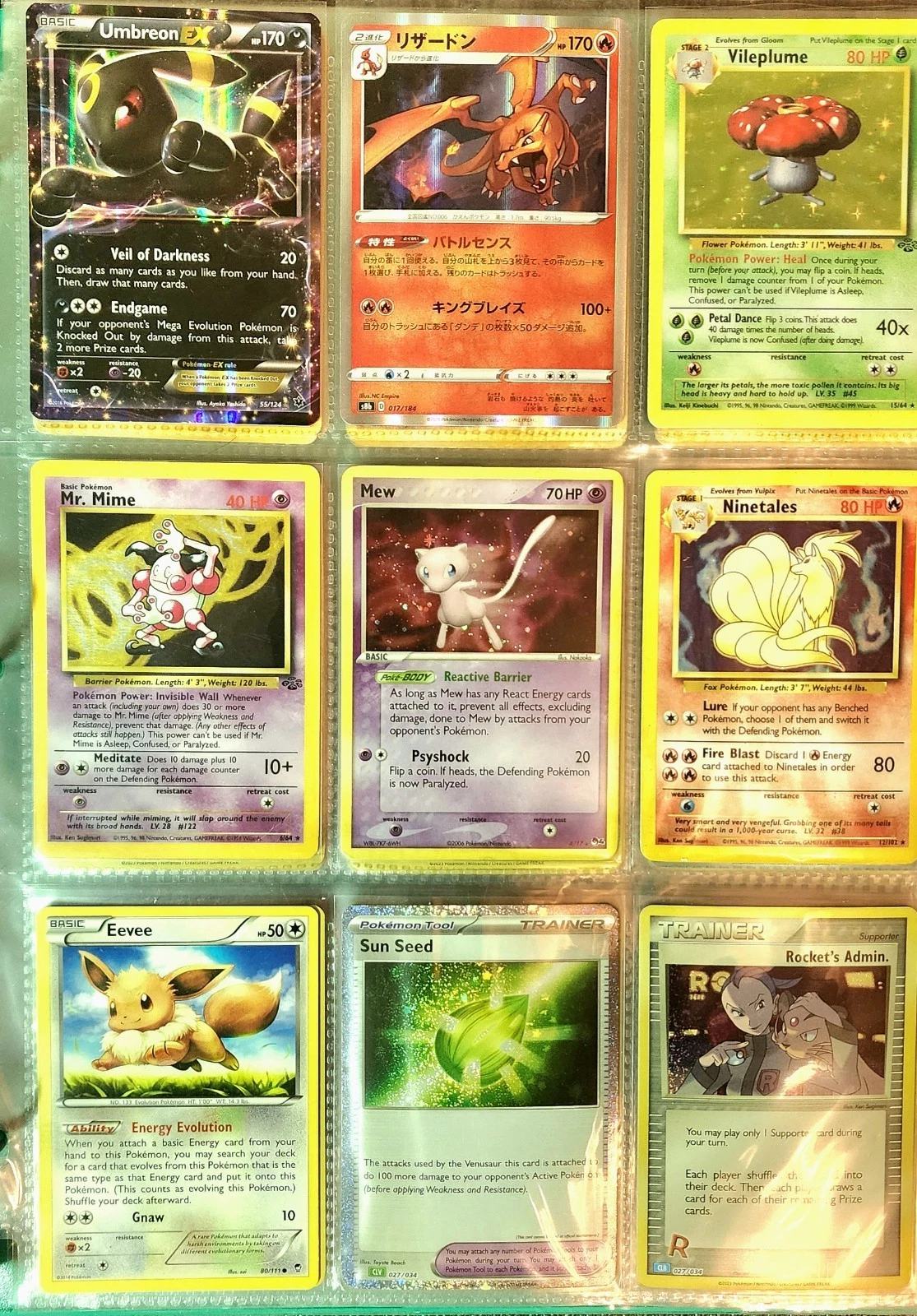
4. Overstuffed binders and the wrong pages
Binders are good storage, with two specific failure modes.
The first is top-loading pages. Cards in a top-loading page slide out whenever the binder is tipped, and they work their way up and out during normal handling, which rounds the corners. Side-loading pages solve this completely and cost very little more.
The second is overstuffing. A binder crammed past its capacity presses the cards in the middle pages against the rings and against each other. Over time that produces indentation along one edge of every card in the affected pages. A binder that does not close easily is a binder that is damaging its contents.
The related mistake is storing a binder flat with other things stacked on top. Binders belong upright, like books.
5. Handling with no sleeves
The last one is the least dramatic and the most frequent.
Every time a raw card is handled, the surface picks up oils and the edges pick up a small amount of wear. None of it matters once. All of it matters across a few hundred times, which is exactly what happens to the cards someone likes enough to keep taking out.
The irony is sharp: the cards you care about most get handled most and end up in worse condition than the ones you forgot about. A penny sleeve costs a fraction of a cent and removes the problem entirely.
The things that are not actually problems
It is worth saying what does not matter, because people worry about the wrong things.
Stacking cards flat is fine, as long as nothing heavy sits on top and the stack is not banded. Keeping cards in a cardboard box is fine. Sorting them by set, or not sorting them at all, makes no difference to condition. Writing on the outside of the box harms nothing.
And a card that has sat sleeved in a closed box for twenty years is almost certainly in better shape than one that has been lovingly displayed for two.
What to do this week
If you want a short list, it is this.
Take off every rubber band. Move anything from an attic, garage, or basement into the house. Turn any binder away from the window, or move it. Sleeve the twenty cards you would be most annoyed to damage. Put bulk upright in a box rather than flat in a pile.
That is an hour of work and it stops essentially all of the ongoing damage. The deeper version, including what to buy and how to organize it, is in how to store Pokemon cards.
Why none of this shows up until you sell
The reason these five do so much damage is that they are all invisible from the front of the card, which is the only angle most people ever look at.
A pressure line from a rubber band shows under angled light and vanishes head on. Warping from a hot attic is obvious when you set the card on a flat surface and almost impossible to see in your hand. Fading only exists in comparison to a copy that did not fade. Corner rounding from a top-loading page happens a fraction of a millimeter at a time.
So a collection can be degrading for a decade while every time you look at it, it looks fine. The first honest assessment usually comes from a buyer or a grader, which is the worst possible time to learn about it.
The fix is to check properly once, under a single bright light at a shallow angle, front and back, before you need the answer. Pokemon card condition guide walks through what you are looking for.
What damage does to a specific number
It helps to put figures on it, because “lowers the value” is too vague to act on.
Take a vintage holo that would sell for roughly $200 in near mint. A soft crease from a rubber band typically drops it into the played range, which on most cards means somewhere between a quarter and a half of the near mint price. Call it $70 to $100, so the band cost somewhere over a hundred dollars on one card.
The same card with edge whitening from a top-loading page but no crease might lose fifteen to twenty-five percent. Fading costs more than people expect, because it is immediately visible in photographs and buyers price it harshly.
None of those are catastrophic on a single common. All of them are painful on the handful of cards in any collection that actually carry the value, and those are exactly the cards that get handled, displayed, and moved around the most.
The short version
Rubber bands, attics, sunlight, overstuffed binders, and bare handling. Those five account for most of the avoidable damage anyone ever does to a collection, and none of them feel like mistakes while they are happening.
All five are free to stop. None are reversible once they have happened, which is the whole reason to deal with them before you need the money rather than after.
Common questions
- What is the fastest way to ruin a Pokemon card collection?
- Rubber bands and attics, in that order. A rubber band presses a permanent line into the top and bottom cards of a stack within months, and an attic cycles through temperature and humidity swings that warp cards and break down the gloss on holos. Both are common, both feel harmless, and both are irreversible.
- Is it bad to keep cards in a shoebox?
- A shoebox is fine as a container. The problem is usually how cards sit inside one: loose, leaning, and shifting every time the box moves. Pack them upright and snug with something filling the gap and a shoebox will do no harm at all.
- Does sunlight actually fade Pokemon cards?
- Yes, and faster than people expect. A card left in indirect daylight for a few months loses saturation in the border and the artwork, and the fading is even across the exposed area, which makes it obvious once you compare it to a second copy.
- Can a damaged card be fixed?
- Essentially no, and attempts usually make it worse. Pressing, cleaning, or trimming all count as alteration, which means a grading company will reject the card rather than grade it. The honest move is to describe the damage accurately and price it accordingly.